Reading Response #6: “City of Brass” by S. A. Chakraborty

An interesting and suspenseful tale, indeed. So far, the book, “City of Brass”, has captured my attention well; I am certainly intrigued. However, credit must begiven where it is due. S.A. Chakraborty, the author, effectively uses rhetoric to depict her character through sarcasm and expected and timely placed conflict.

Often times, sarcasm is not used in books; usually, it is more text and text. So, let’s be a but appreciative when there is something new. By the use ‘she’ and focus on the main character, Nahri, in the book, Chakraborty chose the story to be written in the third person. This choice builds an effective foundation for sarcastic thoughts, thus effectively building a character. For example, Nahri sarcastically thought “the Egyptians were the inheritors of a great civilization whose mighty monuments still littered the land. Oh, no. They were peasants, superstitious fools who ate too many beans”. Such a sarcastic line shows the inherent feelings of Nahri about the current situation. Sarcastic or not, the conversed deep thought is effective in building the strong relationship needed between the main character and audience, thus encouraging the audience to read and learn more. Chakraborty does not shy from using sarcasm and her risk to do so pays off.

From years of experience in literature, it should be a known fact that nothing good comes out of taking a shortcut through a graveyard. So, when Nahri enters the graveyard, the assumption of conflict and possible death is foreshadowed. The choice to create a plot line like this is quite effective. First, the author does not need to build suspense herself. The eerie graveyard setting does so already. In addition, preexisting common knowledge about graveyard in literature helps to build that suspense even further. Everything is set for the big moment. The question in the audience’s mind now is: when will it happen? Chakraborty can choose to do so or not. And she effectively chooses to do so, given the expected circumstances of the audience. If it were not to happen, the audience would more than likely be disappointed and find complaints in the slow pace of the book. Right timing, or kairos is key and Chakraborty understands exactly when and how to utilize it. 
Reading Response #5: “#OwnVoices” by Kat Rosenfield

James Charles vs. Tati Westbrook! Is James Charles CANCELLED? Within a few days of this scandal, Charles lost millions of his subscribers and multiple brand deals. How could one scandal like this end a career? Well, that’s all thanks to Youtube’s notorious Cancel Culture. In recent years, it has even gained traction in the publishing world. Authors now fear for their career if they are not #ownvoices enough, causing unrest among authors about what to write. It really has gone too far. The rules of #ownvoices have become too strict and too politically driven, limiting the amazing books that could be. One should be #ownvoices, but only to an extent; if there is understanding and respect, it should really not be the reason an author is cancelled.

            In the case of Kosko Jackson, the cancel culture was too extreme. Jackson, a black, gay male, already showed that his novel was #ownvoices enough by creating a character that was also a black, gay male. However, his novel was cancelled due to a setting. Now, that’s the extreme. One can understand that people who go through wars live in the harshest time; however, is it really so complex that one needs to tear down a whole career for? As authors with corporate publishing, they already go through a strict drafting process to ensure that it would not offend anyone. This means things are researched and authors try to write them justice. More than likely, Jackson has chosen the Kosovo War simply because he wanted a war setting and it was an event in history. He had no intent to cause disrespect to a culture. In addition, it should be considered that the storyline is not of the Kosovo War; it was about a black, gay man journey of love. Similarly, Alina Boyden, a non-Indian, chose her setting to be 17th century Mughal Empire and was attacked for it. Who even is still alive form the Mughal Empire? It’s history. Both Jackson and Boyden did not appropriate the setting; they used these settings as enhancing backdrops to their story line. Besides, if authors become so concerned with appropriating a setting, the only books that would be written are fantasy books with settings that no one can relate to. The entire genre of historical fiction could be cancelled. Is respect and effort to understand not enough? Or do authors still need to pay the price with their creative soul?

However, there are some extremes that do not respect #ownvoices at all. These are what should be cancelled. In the entertainment industry, it is not unusual to adapt a book for the screen; however, there are lines that should not be crossed, such as white washing. Ursula K. Le Guin, the author of the acclaimed Wizards of Earthsea, became a subject of this. Although a white author, she wrote her novel with characters that were blatantly described as people of color (In the sense of traditional #ownvoives, this could’ve been a violation; however, it seems it was not because it is a high fantasy novel, as I mentioned in the previous paragraph.) On the screenplay, all the characters were all white. What kind of injustice is that! Authors wrote their stories in their #ownvoices, but to have someone come by and completely change that voice is pure disrespect to the author. It should not be done.

            In all honesty, the cancel culture of the publishing world and the #ownvoices movement has its benefits and hold authors accountable for their writing; however, some of its rules are simply too extreme. It is easy to understand why a white person should not write about slavery, or why an American that has never travelled there should not write about living in North Korea. They just don’t know enough about it and there is a lack of clear viewpoint. But a setting should not be what determines the fate of an author and their books. Settings are backdrops are not part of the main storyline; it is there for enhancement and the author’s rhetorical choice. To have the #ownvoices movement be this toxic would only cause fear among authors and a lack of creativity and diversity. Respect and understanding should be established, and then, move on. No need to tear down a life.

Presentation-Building Reflection

As a group, we saw that Thor: The Mighty Avenger has an abundance of rhetorical strategies. We have decided to do the 4 assigned topics, as well as writing style for our 5th member. For our presentation, we have decided everyone will do slides for their topics individually, instead of working collectively on them. However, before we turn it in, one or two our group members will actually go over all the slides again and make them sound and look cohesive. This way our group work is divided individually, including the video, and we all have our own individual contributions. 

Kairos Presentation

Video

Script

Kairos, the lesser known of the rhetorical devices, relates to the perfect timing of something. Throughout the plot of Thor: The Mighty Avenger, the comic authors illustrate kairos symbolically and to enhance the dramatization of certain scenes.

When the characters talk about the idea of Thor’s home, a rainbow appears in the spread. For example, there’s a rainbow that Jane sees when Thor arrives on Earth, symbolizing his departure from his home in Asgard. Its last appearances occur on the last two pages of Issue 2. Here, Jane suggests Thor makes Earth his new home while he finds a way back to Asgard. As shown by these three appearances, the symbolic rainbow is timely placed throughout the comic book when there are new developments and meaning to this notion of ‘home’.

The comic author also uses kairos in order to create suspension. For example, in the scene where Jane stops to help Thor who is getting beaten up by Hyde, the comic author chooses to give Jane the line: “Hmmm…gone QUIET in there. I hope there’s nothing…”. The words and ellipses of this line help create the suspension that something big is about to happen. By the following block, the author breaks it by using a full-page spread to illustrate a dramatic blow to Thor by Hyde. Through this scene, the author effectively built suspension and chose the perfect time to break it in order to dramatize the scene further.

Since Thor is a superhero, the show of strength is crucial. However, Thor does not start off with extreme power. Instead, he gets incredibly beaten up by Hyde and required the help of humans from Midgard, like Jane and Jim. Thor was at his lowest point in terms of strength. As a result, the comic authors chose to perfectly time his ascent to power with the hammer, Mjolnir. By giving him his strength and hammer at his weakest, his power is dramatized and appear even more incredible to the audience.

Comic Project Introduction

In a novel, one expects words to guide the readers through the plot. However, a graphic novel relies on an author’s choices of visual rhetoric to convey the storyline. With only pictures, each choice can make or break the story. In Thor: The Mighty Avenger, visual rhetoric is effectively used throughout to persuade the audience of an incredible story. Throughout the graphic novel, one can find visual rhetoric in every part of the novel, from the color to the characters’ appearance. In regard to color, the comic authors choose to use contrasting colors to depict the mood and differences. Brighter colors signify positive emotions while darker colors signify conflict and trouble. As lighting and colors guide the audience’s pathos, onomatopoeia help guide the audience’s audio, as if they were watching a movie. As pictures on the paper portray the story, these sounds are perfectly timed to help replicate the scene more accurately in the audience’s imagination. Besides the ethos and kairos established with sound, the author choices also make logical sense. Characters are drawn with specificity to ensure a correct first impression can be derived, such as a misshapen, villainous Hyde. Lastly, the comic authors put their own writing and visual flair in, rendering Thor: The Mighty Avenger a one-of-a-kind novel.

Despite the change to online classes, our team managed to get this project done with very few problems. We had already assigned our roles for the project, so everyone knew exactly what they needed to do. We all trusted each other, too. Just in case, we kept an active communication group chat to give each other reminders and help. In addition, we finished all of the filming before the change, thus not requiring us to meet up at all. Please enjoy our project!

Rhetoric of Emojis

A screenshot of a cell phone

Description automatically generated

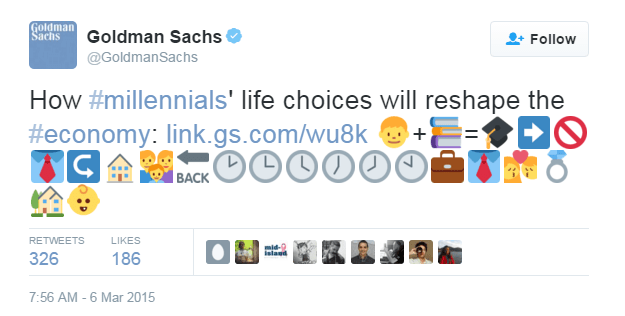
Speaker/Ethos The post is written by a well-respected banking company, Goldman Sachs, and the topic of the post relates to its industry.

Audience/Pathos This post is for millennials, and it is appealed to them by directly addressing them and stating their ability to “reshape”.

Message/Logos The emojis in the post give a summary of how the worded message is possible, such as the first 3 emojis, indicating an educated generation.

Situation/Kairos In 2015, the economy and Goldman Sachs were recovering from the 2008 Recession, thus a post like this is perfectly timed to encourage the next generation to do better.

Effectiveness Although I am not a millennial, as a Gen Z, I can relate in wanting an ideal life, such as what the emojis depict, thus encouraging me to press the article link. It is effective.

Reading Response #4: “Twilight” by Stephanie Meyers

Caricature

Caricatures can help to foreshadow characters through carefully selected descriptive words. In Meyers chooses to use this device when Bella sees the Cullens. She describes the Cullens as “all devastatingly, inhumanly beautiful” and “noticeably graceful” in a manner that “was unsettling to watch” (19, 23). They are literal descriptions of the characters, however; readers of the novel will soon realize that these words show they are actually vampires.

Dilemma

Stephanie Meyers chooses to start the novel by introducing an ending to a dilemma. It becomes apparent that Bella “detested Forks” yet she has “now exiled [her]self” to Forks for her mom (3-4). This choice in her dilemma will plays out in the next few chapters of how she will adapt to life at Forks. It helps to create suspense and tension within the novel from the very first page.

Hyperbole

It becomes obvious that Bella absolutely hates the rain and cold from the first few chapters. One of the ways Stephanie Meyers depicts this is through the use of a hyperbole: “I donned my jacket which had the feel of a biohazard suit” (12). A biohazard suit is known to be heavy and used in the case of a disastrous event. However, here it is compared to a simple jacket and in case of some drizzling rain.

Idiom

Idioms have a way of expressing ideas in comical or uncharacteristic words. In Twilight, Bella expresses that her car engine “roars to life” (12). Her car is not a lion roaring. Instead, this phrase means that her car runs, and the roar is the noise the engine makes when it starts. Phrases like these should not be taken as a literal but taken into context of the situation and the culture.

Symbolism

Symbolism can help increase the severity and contrast of a situation. For example, in Twilight, when Bella’s mom is taking her to airport, she expresses her home and soon-to-be new home in through her clothes: “I was wearing my favorite shirt — sleeveless, white eyelet lace; I was wearing it as a farewell gesture. My carry-on item was a parka” (3). It becomes obvious she loves Phoenix’s warm weather, depicted by the words “favorite” and “sleeveless”. The mention of the parka, tucked away in her carry-on, shows that she will be going somewhere cold.  

Flashback

In real life, people have flashbacks about their life when looking at old pictures or even coming back to a certain location. The same things happen to Bella when she comes to Charlie’s house. She has flashbacks of her mother’s painted cabinets, her room, and the pictures around the house (11).

Pathetic Fallacy

Although similar to personification, pathetic fallacy actually gives “human emotions to inanimate objects” (literarydevice.net). Stephanie Meyers uses this to further her efforts of depicting Bella’s detest for Forks: “Thick fog was all I could see out my window in the morning, and I could feel the claustrophobia creeping up on me” (11). Due to the weather of Forks, she feels claustrophobia, a human feeling.

Cliffhanger

if I had never heard of the book or the movie, this would have been a cliffhanger. After the dramatic car scene incident, Bella presses for the truth form Edward; however, he refuses to tell and “walked away” (68-69). Both Bella and the audience are left without the truth and at this point, we all want to know. Another cliffhanger is developed when Bella admits of the “first night [she] dreamed of Edward Cullen” (70). By this point, the audience is invested in their budding relationship and wants to know of her dream as well. Much is left unknown for audience and the suspense causes them to want to read the next chapter.

Understanding Comics

Amplification through Simplification. Never truer words spoken. As a data analytics major, I can appreciate this lesson. Data comes in large batches and can be increasingly complicated. However, the more complicated it is, the more confusing it can be. For most, data speaks the truth; however, the truth depends on how you interpret it. If one looks too hard into a dataset, they can come up with completely complex yet wrong interpretations, instead of simple yet right interpretations. In addition, complex visuals are even less effective than simple visuals. Similarly, comics try to depict a story simply through pictures. Words in a novel can be complex, but those words in pictures are much simpler and can be easily interpreted, especially when they are drawn to the bare minimum. This allows for comics not to appear cluttered and more complex than it needs to be. Not everything in life needs to be complicated; they can be simple like comics. Now, only if I can apply that to my data analysis.

Reading Response #3: “Harry Potter” by J. K. Rowling

Onomatopoeia

In Harry Potter, Rowling effectively uses onomatopoeia to disrupt the established scene: “BOOM. The whole shack shivered, and Harry sat bolt upright…Someone was outside, knocking to come in” (45). The word “BOOM” allows us to visualize the knocking at the door in the current scene and redirects our attention to a potentially new scene, set off by the sound.

Simile

A scent can be hard to describe but using a familiar sight and smell to the audience can create a just as accurate of a description. In the third chapter, Harry describes “the horrible smell in the kitchen” to be coming from a tub “full of what looked like dirty rags swimming in grey water” (33). By using this simile, the audience can visualize and smell the dirty rags, better communicating the scene Harry is experiencing.

Bdelygmia

In literature, an author can choose to write a humorous insult, instead of a hurtful insult, especially in children’s books like Harry Potter. To put it simply, Rowling could have written Dudley’s appearance in Harry’s eyes as an “ugly troll”; however, she chooses to describe Dudley as “a pig in a wig” (21). Because the image is quite funny, it lessens the offensive strength of the insult, creating a real, but bad insult.

Anthropomorphism

Animals may seem insignificant, especially a cat on the street. However, the author can draw particular attention to it using anthropomorphism. This technique allows the author to give human characteristics to animals, bringing them into the real life and making them seem more alive. For example, Rowling describes the cat giving “a stern look” and “reading the sign”, instead of the animal-like characteristic of “looking” (3, 6). For the purpose of Harry Potter, this technique helps foreshadows the cat’s importance in the book.

Imagery

Authors describe their settings with the senses, just as their characters and audience would in a new setting. In Harry Potter, the “broken-down house” is described as “smell[ing] strongly of seaweed, the wind whistl[ing]…and the fireplace as damp and empty” (44). This description utilizes the audience’s senses of smell, sound, sight, and touch to effectively describe the horrible setting.

Metaphor

Similar to a simile, a metaphor can also help compare things, just without the use of “like” and “as”. These literary devices can also add more emphasis and clarity to a scene. For example, when describing the color changes of Uncle Vernon’s face, they were compared to a “set of traffic lights” and “old porridge” (35). These very distinct colors help our visualization of an angry, disgusted, and scared expressions more intensely. In some ways, these colored metaphors are all we need to imagine Uncle Vernon’s emotions in this scene.

Diacope

Diacope can be used to bring extra emphasis on a particular thought. For example, in Harry Potter, it is obvious that the Dursleys absolutely hate Harry; however, Rowling puts even more emphasis when describing Mr. Dursley’s complaints: “He liked to complain about things: people at work, Harry, the council, Harry, the bank, and Harry were just a few of his favorite subjects” (25). The constant repetition of “Harry” emphasizes his extreme hate for Harry.

Hyperbole

Hyperbole can make a story seem more dramatic than it really is. For example, when Pier and Dudley told the story of the boa constrictor, they exaggerated the actions of the it and what happened. In reality, the snake “snap playfully at his heels”, but in their version of the story, they told of how it “nearly bitten his leg off” and “squeeze him to death” (29). This version of the story allows for more dramatic and near-death experience. Now, it seemed to have become a cool story to tell than about the danger of it.

Design a site like this with WordPress.com
Get started